


09 Oct HR LAW NEWSLETTER – SEPTEMBER 2026


In the September 2026 HR Law Newsletter, we discuss the Competition and Fair Work Legislation Amendment (Banning Unfair Non-Competes) Bill 2026, recent Right to Disconnect decisions, and the Fair Work Commission’s Guidance Note: Use of Generative Artificial Intelligence in Commission Cases, which commences on 20 October 2026.
Further, we analyse the Fair Work Commission’s decisions in Wendy Margaret Mathews v Greater Shepparton City Council [2026] FWC 3351 concerning flexible working arrangements as well as Jeffrey Asuncion v ConnectOS Pty Ltd and Ors [2026] FWC 3379 regarding the geographical reach of general protections claims for overseas-based employees.

1.
Bill Alert – Competition and Fair Work Legislation Amendment (Banning Unfair Non-Competes)
Bill 2026
Draft legislation has been released proposing significant changes to both the Fair Work Act 2009 (Cth) (“FW Act”) and the Competition and Consumer Act 2010 (Cth) (“Competition and Consumer Act”) in relation to non-poach and wage-fixing agreements, and non-solicitation and non-compete clauses.
Competition and Consumer Act: No-Poach and Wage-Fixing Agreements
The draft legislation proposes to expand Part IV of the Competition and Consumer Act, otherwise referred to as the cartel laws, to prohibit:
•
no-poach agreements between businesses that restrict or prevent the hiring of employees; and
•
wage-fixing agreements that fix, cap or control employee remuneration or other employment conditions.
The proposed no-poach agreement prohibition will apply to arrangements concerning former employees, meaning a former employee would be able to poach a former colleague to work for them.
The proposed wage-fixing agreement prohibition will apply to current and prospective employees.
The draft legislation includes narrowly defined exemptions for some no-poach and wage-fixing arrangements connected with legitimate business activities, including certain joint ventures, secondments, labour-hire arrangements and professional sporting leagues. These exemptions are subject to specific conditions and are not blanket exclusions.
The Australian Competition and Consumer Commission (“ACCC”) would be responsible for investigating and enforcing the proposed changes.
Significant civil and criminal penalties may apply to businesses that enter into, attempt to enter into, or give effect to prohibited no-poach or wage-fixing arrangements.
FW Act: Ban on Non-Compete and Non-Solicitation Clauses
The draft legislation proposes to alter the FW Act by prohibiting post-employment non-compete clauses for employees earning at or below the high income threshold (currently $190,100 per annum FY26/27).
For employees whose earnings exceed the high income threshold, post-employment non-compete clauses would only be permitted where they:
•
protect specified legitimate business interests;
•
are reasonable in scope and duration; and
•
do not contain cascading time or geographic restraints.
It would also prohibit co-worker non-solicitation clauses for all employees, regardless of income.
The reforms would apply broadly to employment contracts, workplace policies and other employment arrangements, including deeds and workplace policies.
It is proposed that employees, prospective employees, unions and Fair Work Inspectors would have standing to commence proceedings in relation to alleged contraventions.
Importantly, appropriately drafted confidentiality and non-disclosure provisions will continue to be permitted. However, confidentiality clauses drafted too broadly may be characterised as prohibited non-compete clauses.
Where non-compete restraints remain permissible, they may only protect specified legitimate business interests and must be reasonable in scope and duration. The reforms would also ban “cascading” restraint clauses, meaning employers could no longer include multiple alternative time periods or geographic restrictions within a single restraint provision.
Modern Awards and Enterprise Agreements
The proposed reforms would extend beyond employment contracts and also apply to modern awards, enterprise agreements and workplace determinations.
As a result, any non-compete or co-worker non-solicitation terms contained in these industrial instruments may become unenforceable if the legislation is passed in its current form.
What should Employers do?
Employers should consider reviewing their:
•
employment contracts, specifically with regards to restraint of trade and non-solicitation clauses; and
•
workplace policies.
Employers should start thinking of alternative ways to ensure that their business interests are protected. If this is something you require assistance with, please contact us at info@hrlaw.com.au.
For more information, please see the Bill home page here – https://consult.treasury.gov.au/c2026-801178
2.
Reminder – Guidance Note: Use of generative artificial intelligence in Commission cases starts on 20 October 2026
On 24 August 2026, President Justice Adam Hatcher of the Fair Work Commission (“Commission”) published a statement announcing the release of the Commission’s new Guidance Note: Use of generative artificial intelligence in Commission cases.
The Guidance Note will apply from 20 October 2026 and sets out practical requirements for parties who use generative AI to prepare applications, submissions, witness statements or any other documents to be lodged in Commission proceedings.
In summary, where GenAI is used to prepare documents in Commission proceedings, parties will be required to:
•
disclose when and how GenAI has been used;
•
check the document and make any necessary changes to ensure that its contents are correct and relevant, including verifying that any facts, evidence and legal authorities referred to exist and support the propositions for which they are cited;
•
where the document is a witness statement or declaration, a party must ensure that it reflects the witness’ own knowledge and words and is true to the best of their knowledge.
The Guidance Note reflects a broader shift in how workplace disputes are being prepared and presented. While GenAI may assist parties to organise information, draft documents and better understand the Commission process, it also creates risks where parties rely on AI-generated material without properly checking its accuracy. Those risks include misstated facts, incorrect legal propositions, fabricated authorities, inappropriate disclosure of confidential information and witness evidence that does not properly reflect the witness’ own recollection.
The increased use of GenAI is likely to change the way Commission matters are managed, particularly in unfair dismissal, general protections and other individual employment claims. Employers may see more detailed or legally framed applications from self-represented applicants, but those documents may not always be accurate or properly supported. This may require employers to more carefully scrutinise applications, submissions and evidence for inaccuracies, unsupported allegations, incorrect legal references and signs that AI-generated content has been used without proper verification.
Accordingly, employers and HR teams should ensure that any use of GenAI in Commission matters is carefully supervised, checked and disclosed in accordance with the new requirements. In practice, employers should have appropriate procedures in place including:
•
maintaining clear internal processes for the use of AI in workplace disputes;
•
ensuring documents are reviewed by an appropriate person before filing;
•
protecting confidential and personal information;
•
ensuring witness statements remain accurate, personal and based on the witness’ own knowledge; and
•
being prepared to challenge AI-generated material where it appears inaccurate, irrelevant or unsupported by evidence.
3.
First Reported Right to Disconnect Decisions – Kalleske v McGuire [2026] SAET 106 and Elliot v McGuire [2026] SAET 107
The South Australian Employment Tribunal has delivered what is understood to be the first reported decision considering Australia’s right to disconnect provisions, finding that an employer’s after-hours communications and apparent disapproval when employees failed to respond did not amount to a breach of the right to disconnect because the employees were not prevented from exercising that right.
Broadly, the right to disconnect entitlement allows employees to refuse to monitor, read or respond to unreasonable work-related communications outside of working hours. Modern awards also prohibit an employer from directly or indirectly preventing an employee from exercising that right.
In these cases, the Applicants were apprentice hairdressers employed by Eco Hair Room (“Respondent”). The proceedings arose from a number of alleged breaches of the Hair and Beauty Industry Award 2020 (“Award”) and the Fair Work Act 2009 (Cth) (“FW Act”), including allegations that the Respondent had contravened the Award’s right to disconnect provisions.
The Applicants alleged that the Respondent would regularly contact them via social media outside working hours. The communications were said to relate primarily to the Respondent’s social life, although some concerned non-urgent work matters. The Applicants alleged that when they did not respond to those communications prior to returning to work, the Respondent would be in a bad mood or ignore them. They contended that this created pressure to engage with the communications outside working hours. One Applicant also alleged that the Respondent asked her to take the salon mobile phone home during a long weekend and monitor messages without payment. Although she took the phone home, she informed the Respondent that she would not monitor it.
The Tribunal dismissed the right to disconnect claims, finding that the key question was whether the employer had prevented the employees from exercising their right to disconnect. While the employer’s conduct may have placed some pressure on the employees, the evidence showed they did not always respond and were able to refuse requests without consequence.
Importantly, the Tribunal distinguished between conduct that discourages an employee from disconnecting and conduct that actually prevents them from exercising the right.
Although the right to disconnect claims were unsuccessful, the Tribunal found the employer had committed several serious breaches of the Award and the FW Act, including failures relating to wages, rosters, breaks, TAFE fee reimbursements and superannuation. The issue of penalties is yet to be determined.
These Decisions provide useful guidance for employers on the operation of the right to disconnect provisions and suggests that employee discomfort or perceived pressure alone may not be sufficient to establish a breach.
To read the Decisions, please see:
Kalleske v McGuire [2026] SAET 106:
https://www.austlii.edu.au/cgi-bin/viewdoc/au/cases/sa/SAET/2026/106.html
Elliot v McGuire [2026] SAET 107:
https://www.austlii.edu.au/cgi-bin/viewdoc/au/cases/sa/SAET/2026/107.html
4.
FWC Considers Geographical Reach of General Protections Claims for Overseas-Based Employees
In the recent case of Jeffrey Asuncion v ConnectOS Pty Ltd and Ors [2026] FWC 3379, the Fair Work Commission (“FWC”) has dismissed a general protections application brought by a Philippines-based employee after finding that the general protections provisions in Part 3-1 of the Fair Work Act 2009 (Cth) (“FW Act”) did not apply to his employment.
Mr Asuncion (“the Applicant”) was employed by ConnectOS-RHQ (“the Employer”) in the position of Head of Offshore Delivery and worked from the Philippines. Following the termination of his employment at the end of his probationary period, he commenced a general protections application in the Fair Work Commission. The Applicant argued that the Employer is an emanation of Melbourne-headquartered outsourcing company ConnectOS. The Employer raised a jurisdictional objection, arguing that the applicant’s employment fell outside the geographical reach of the Fair Work Act.
The FWC considered whether Part 3-1 of the FW Act applies to an employee working overseas for an Australian employer. President Hatcher observed that existing authority suggests the provisions only apply where a worker is both employed by an Australian employer and is an “Australian-based employee“.
While President Hatcher expressed doubt about whether that interpretation of the law is correct, and indicated that a broader interpretation may be open, President Hatcher ultimately followed the existing authority.
The FWC accepted that the Applicant was employed by an Australian employer. However, because his primary place of work was in the Philippines, he was not an Australian-based employee. As a result, the FWC found that the general protections provisions did not apply and dismissed the application.
The Decision is an important reminder that jurisdictional issues can be critical where employees work outside Australia. It also highlights that the law in this area may continue to develop, given President Hatcher’s comments regarding the interpretation of the Fair Work Regulations.
Employers engaging overseas-based workers should ensure employment arrangements clearly identify the employing entity, place of work and applicable legal framework, particularly where operations involve Australian and overseas corporate entities.
To read the Decision, please see:
https://www.fwc.gov.au/documents/decisionssigned/pdf/2026fwc3379.pdf

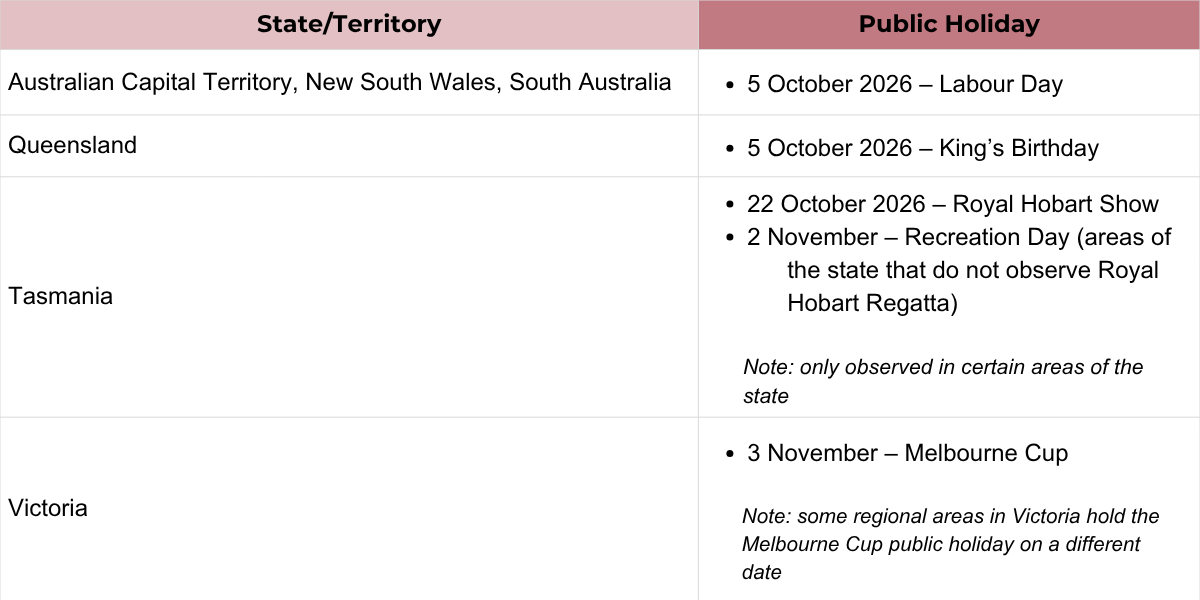
Employers should also ensure they check for any region-specific public holidays, including local show holidays.

OVERVIEW
The Fair Work Commission (“FWC”) has upheld Greater Shepparton City Council’s (“the Respondent”) refusal of a flexible working arrangement requested by Ms Wendy Mathews (“the Applicant”), finding that aligning employees’ rostered hours with the Visitor Centre’s revised opening hours and maintaining two employees on site for safety reasons each constituted reasonable business grounds.
BACKGROUND
The Applicant was employed by the Respondent as a Visitor Services Officer at its Visitor Centre. Since 2021, she had worked 21 hours and 45 minutes each week across Sunday, Monday and Tuesday, ordinarily from 9:00 am to 5:15 pm.
Following safety concerns about employees working alone, including an incident involving threatening behaviour near the Visitor Centre, the Respondent reviewed the Centre’s operations. The review resulted in a decision to align the Centre’s opening hours with those of the adjoining Shepparton Art Museum and to roster two paid employees at all times during operating hours.
The proposed changes reduced the Applicant’s Sunday span of hours. The Respondent consulted with her and offered several alternatives that preserved her total weekly hours, including redistributing the affected time across Monday and Tuesday and shortening her lunch breaks.
The Applicant sought to retain her existing hours and proposed working from home between 9:00 am and 9:45 am and between 4:15 pm and 5:15 pm on Sundays. The Respondent refused that proposal, relying on the operational need for employees to work during the Centre’s opening hours and its health and safety objective of maintaining two employees on site.
The dispute was unsuccessfully conciliated and was referred to arbitration under clause 2.16 of the Greater Shepparton City Council Enterprise Agreement 2024 and section 739 of the Fair Work Act 2009 (Cth) (“FW Act”).
THE LAW
Section 65 of the FW Act provides eligible employees with a right to request a change in working arrangements in specified circumstances. Under section 65A, an employer must respond to a written request within 21 days and may refuse it only where the prescribed consultation requirements have been met and reasonable business grounds support the refusal.
Section 65B allows the FWC to deal with disputes about flexible working arrangement requests. Relevant reasonable business grounds may include cost, lack of capacity to reorganise work, impracticability of changing other employees’ arrangements or recruiting new employees, likely significant loss of efficiency or productivity, and likely significant negative impact on customer service.
Clause 6.2 of the Agreement supported the National Employment Standards entitlement to request flexible working arrangements. The parties agreed that the issue for determination was whether the Respondent had reasonable business grounds for refusing the Applicant’s request.
Relying on Paper Australia v May [2025] FWCFB 224, the FWC observed that “reasonable business grounds” bears its ordinary meaning and directs attention to whether the employer has a rational or sound business justification connected with the effect of granting the request on the relevant business.
THE FINDINGS
Deputy President Farouque found that each of the Respondent’s two reasons for refusal constituted a reasonable business ground.
First, the Respondent had a proper operational justification for aligning rostered hours with the Visitor Centre’s revised opening hours. The Centre’s substantial purpose was to provide services to members of the public while open. The Applicant’s proposal would have required her to commence work one hour before the Centre opened on Sundays, rather than 15 minutes beforehand under the revised roster.
Secondly, the Respondent’s decision to roster two employees at all times was a rational safety measure. The Visitor Centre was a public access facility and the arrangement followed an earlier incident involving threatening behaviour. The fact that the immediate threat was no longer occurring did not make it unreasonable for the Respondent to assess that two employees should remain present. Nor did evidence that some employees worked alone elsewhere in the Respondent’s operations undermine the safety justification applying to this facility.
The Applicant argued that she could work alone behind locked doors outside opening hours. However, this did not address the Respondent’s separate operational objective of aligning working hours with the Centre’s public opening hours.
The FWC also accepted that the Respondent had considered the Applicant’s personal circumstances, including her preference for consistent start times to manage sleep issues. The Respondent had responded by proposing an additional option with a later start and shorter lunch break while preserving her total hours. Her personal preferences did not displace the Respondent’s reasonable business grounds.
Accordingly, the FWC determined that the Respondent had reasonable business grounds for refusing the requested flexible working arrangement.
WHAT THIS MEANS FOR EMPLOYERS
This decision confirms that operational requirements and employee health and safety obligations may each provide reasonable business grounds for refusing a flexible working arrangement, provided the grounds are rational, evidence-based and connected to the practical effect of granting the request.
Employers should carefully assess each request on its individual circumstances and document the operational or safety considerations supporting any proposed refusal. Relevant evidence may include operating hours, service requirements, risk assessments, incident reports, staffing models and the practical effect of the requested arrangement.
The decision also demonstrates the importance of genuine consultation. Before refusing a request, employers should discuss the request with the employee, consider their personal circumstances and explore reasonable alternatives. Offering options that address the employee’s concerns while preserving essential operational and safety requirements may assist in demonstrating that the request was properly considered.
Accordingly, employers should ensure that any refusal identifies the specific reasonable business grounds relied upon, explains how those grounds apply to the request and records the alternatives considered.
If you require advice on flexible working arrangements or responding to flexible work requests, please contact us at info@hrlaw.com.au or one of our experienced solicitors.
To read the case, please see the link below:
https://www.fwc.gov.au/documents/decisionssigned/pdf/2026fwc3351.pdf

The Fair Work Ombudsman recently revealed that more than $450 million in unpaid wages and entitlements was recovered for over 181,000 workers during the 2025-26 financial year.
This represents a 27% increase in recovered underpayments compared with the previous financial year, with almost half of the total amount recovered arising from large corporate employers.
The Fair Work Ombudsman also reported that it almost doubled its proactive investigations during the year, undertaking more than 2,680 investigations, particularly in priority sectors including construction and disability support services.
If you would like advice on payroll compliance, wage audits, modern award obligations or responding to an investigation by the Fair Work Ombudsman, please contact our experienced team at info@hrlaw.com.au.
If you would like advice on any of the matters outlined in our September 2026 Newsletter or need advice on any other workplace matter, please contact our experienced team at info@hrlaw.com.au


Are you following our LinkedIn? For updates on new laws, cases and inquiries as they happen follow us here: https://www.linkedin.com/company/hr-law/
No Comments