


04 Aug HR LAW NEWSLETTER – JULY 2026


In the July 2026 HR Law Newsletter, we discuss recent legislative developments affecting employers, including the commencement of Payday Super, changes to paid parental leave and workplace health and safety obligations, developments in positive duty enforcement, the Federal Government’s proposal for a Fair Work Court, and the upcoming Federal Court delegates’ rights litigation. We also provide a case brief on a recent Fair Work Commission decision concerning capacity-based dismissal and an employee’s obligation to participate in return to work processes.

1.
Recent Legislation Amendments
We remind and inform employers of the following amendments and changes:

| Corporations Act 2001 (Cth) |
The advertising of certain superannuation products to new employees during onboarding will be prohibited.
Limited advertising of certain MySuper products is permitted where the product has passed the most recent Australian Prudential Regulation Authority (“APRA”) performance test, the advertising is not undertaken by a connected entity, and employees have first been informed of any stapled fund.
Employers may also continue to provide information about an employee’s stapled fund or the employer’s default fund.
In addition, content distributors are exempt where they act in the ordinary course of business and were not aware the material breached the prohibition.
Parties seeking to rely on an exception will bear the evidential burden of demonstrating compliance.
1 July 2026
| Superannuation Guarantee (Administration) Act 1992 (Cth) |
Payday Superannuation requires employers to make superannuation contributions for each employee in connection with each pay cycle, rather than on a quarterly basis.
However, Payday Super involves more than simply aligning payment frequency with payroll cycles.
In particular, employers should be aware that:
- superannuation contributions must be received by an employee’s superannuation fund within seven (7) business days of each payday (rather than merely processed or submitted on payday), subject to limited exceptions (e.g., for new employees);
- superannuation guarantee contributions will be calculated as 12% of “qualifying earnings” (“QE”), a new statutory concept which largely replaces ordinary time earnings for superannuation purposes; and
- Single Touch Payroll (“STP”) reporting obligations will change, requiring employers to report both qualifying earnings and superannuation liability as part of their regular payroll reporting.
For Small Businesses, the Small Business Superannuation Clearing House (“SBSCH”) will close, and employers must transition to alternative payment methods. If you currently use the SBSCH, you will need to select a new way to pay super. We recommend that this is ideally one that integrates with your payroll software.
Please note that late or missed superannuation payments may expose employers to the Superannuation Guarantee Charge (“SGC”) and other enforcement action by the Australian Taxation Office.
1 July 2026
| Paid Parental Leave Act 2010 (Cth) |
The Federal Government Paid Parental Leave Scheme has increased from 24 weeks to 26 weeks for eligible children born or adopted on or after 1 July 2026.
The increase forms part of the continued expansion of the Scheme and provides additional Government-funded leave for eligible parents.
Employers should review parental leave policies, forms and employee communications to ensure they accurately reflect the current entitlement and any interaction with employer-funded parental leave benefits.
1 July 2026

| Section 26A of the Work Health and Safety Act 2011 (NSW) |
The introduction of section 26A of the Work Health and Safety Act 2011 (NSW) requires Persons Conducting a Business or Undertaking (“PCBU”) to comply with applicable Workplace Health and Safety Codes of Practice or otherwise demonstrate that they have implemented measures that provide an equivalent or higher standard of health and safety. The Codes are now regarded as minimum performance standards rather than guidance material alone.
Please see the applicable Codes of Practice here – https://www.safework.nsw.gov.au/resource-library/codes-of-practice.
Of particular importance is the Managing Psychosocial Hazards at Work Code of Practice (the “Code”), which requires employers to implement a systematic process for managing psychosocial risks in the workplace, including identifying psychosocial hazards, assessing risks, implementing appropriate control measures and reviewing their effectiveness.
The Code identifies the following psychosocial hazards including but not limited to:
- high job demands;
- role conflict or lack of role clarity;
- low job control;
- inadequate support;
- workplace violence;
- bullying;
- harassment; and
- poor organisational change consultation.
The Code can be found here – https://www.safework.nsw.gov.au/resource-library/codes-of-practice/codes-of-practice/managing-psychosocial-hazards-at-work.
1 July 2026

The commencement of the Restricting Non-disclosure Agreements (Sexual Harassment at Work) Act 2025 (Vic) from 1 July 2026 limits the circumstances in which non-disclosure agreements (“NDA”) can be used in workplace sexual harassment matters. The reforms are intended to prevent NDAs from being used to conceal workplace sexual harassment and to ensure that confidentiality is not treated as the default position in these matters.
The Act applies where a worker, including a volunteer, has reported sexual harassment at work or in connection with work. In broad terms, an NDA that prevents the worker from speaking about their experience, or from naming the person who sexually harassed them where that person was 18 years or older, will only be lawful and enforceable if the statutory preconditions have been met.
Of particular importance is that an NDA must be requested by the complainant and entered into by choice, without undue pressure or influence. The NDA must also be written in plain language, and the complainant must be given the required information statement and a 21-day review period before signing, unless the complainant requests a shorter period or waives the review period.
Each party must also acknowledge, in the approved form, that the relevant preconditions have been met. If those preconditions are not satisfied, the NDA will not be enforceable against the complainant.
What should employers do?
Employers should review their workplace policies, procedures and practices relating to complaints, investigations, dispute resolution, settlements and confidentiality arrangements to ensure they remain appropriate and compliant with current obligations.
If you wish to read more information about the changes, refer to the Victorian Government’s Guidance here – https://www.vic.gov.au/restricting-non-disclosure-agreements-sexual-harassment-work-act-2025
1 July 2026
2.
Human Rights Commission Inquires – Sexual Harassment Positive Duty Enforcement
The Australian Human Rights Commission (“AHRC”) has confirmed that it is actively enforcing employers’ positive duty obligations, with six formal inquiries currently underway and a further 18 employers being monitored for potential non-compliance.
Since the positive duty provisions commenced in December 2023, the AHRC has received 143 complaints alleging breaches of an employer’s obligation to take reasonable and proportionate measures to eliminate workplace sex discrimination, sexual harassment, hostile workplace environments and victimisation, as far as possible.
Sex Discrimination Commissioner Anna Cody has described the positive duty regime as a “game changer“, noting that complaints relating to sexual harassment and workplace conduct continue to increase across both the AHRC and the Fair Work Commission. The AHRC has reported a steady rise in employment-related sex discrimination and sexual harassment complaints, increasing from 395 complaints in 2023–24 to 545 complaints in 2025–26.
Importantly, the AHRC now has powers to investigate employers proactively, including where concerns arise from complaints, media reports, or other sources. Where the Commission reasonably suspects non-compliance, it can conduct a formal inquiry, request information, issue recommendations or compliance notices, and ultimately seek enforcement through the courts.
The Commission has indicated that its preferred approach remains collaborative rather than punitive, with many employers voluntarily working alongside the AHRC to strengthen policies, training, reporting mechanisms and workplace culture. However, where concerns remain unresolved, formal regulatory action may follow.
What Employers Should Do Now
The AHRC’s increased enforcement activity is a timely reminder that employers must move beyond a reactive complaints-based approach and take active steps to prevent unlawful workplace conduct before issues arise.
If you would like assistance reviewing your organisation’s compliance with its positive duty, please contact the HR Law team.
3.
Proposal for the Fair Work Court
The Federal Government has announced plans to establish a Fair Work Court, with consultation on the design of the proposed court expected to commence later this year.
The proposed court would operate alongside the Fair Work Commission and is intended to provide a dedicated pathway for the resolution of workplace disputes, including underpayment claims up to $100,000.00.
The Government has indicated that consultation will focus on the structure and operation of the court, including its interaction with the Fair Work Commission and how it may support workers and employers in resolving workplace disputes.
At this stage, no legislation has been introduced and details regarding the court’s jurisdiction, powers and procedures have not yet been released.
We will continue to monitor developments in this area, as the proposed court may result in changes to how workplace disputes and compliance matters are resolved in future.
4.
Upcoming Landmark Delegates’ Rights Case
The first Federal Court case to consider the delegates’ rights provisions introduced by the Fair Work Legislation Amendment (Closing Loopholes) Act 2023 (Cth) is set to commence on 4 August 2026 and is expected to run for two days.
The Australasian Meat Industry Employees’ Union (“AMIEU”) has brought proceedings against Teys Australia, seeking declarations regarding the scope of a workplace delegate’s rights, including rights to attend inductions, post information on workplace noticeboards and conduct meetings in workplace facilities.
The matter is also expected to consider allegations that adverse action was taken against a workplace delegate after he sought to exercise those rights.
As the first case to litigate the amended delegates’ rights, the decision is expected to provide important guidance on the operation and practical limits of delegates’ rights under the Fair Work Act 2009 (Cth), modern awards and enterprise agreements.

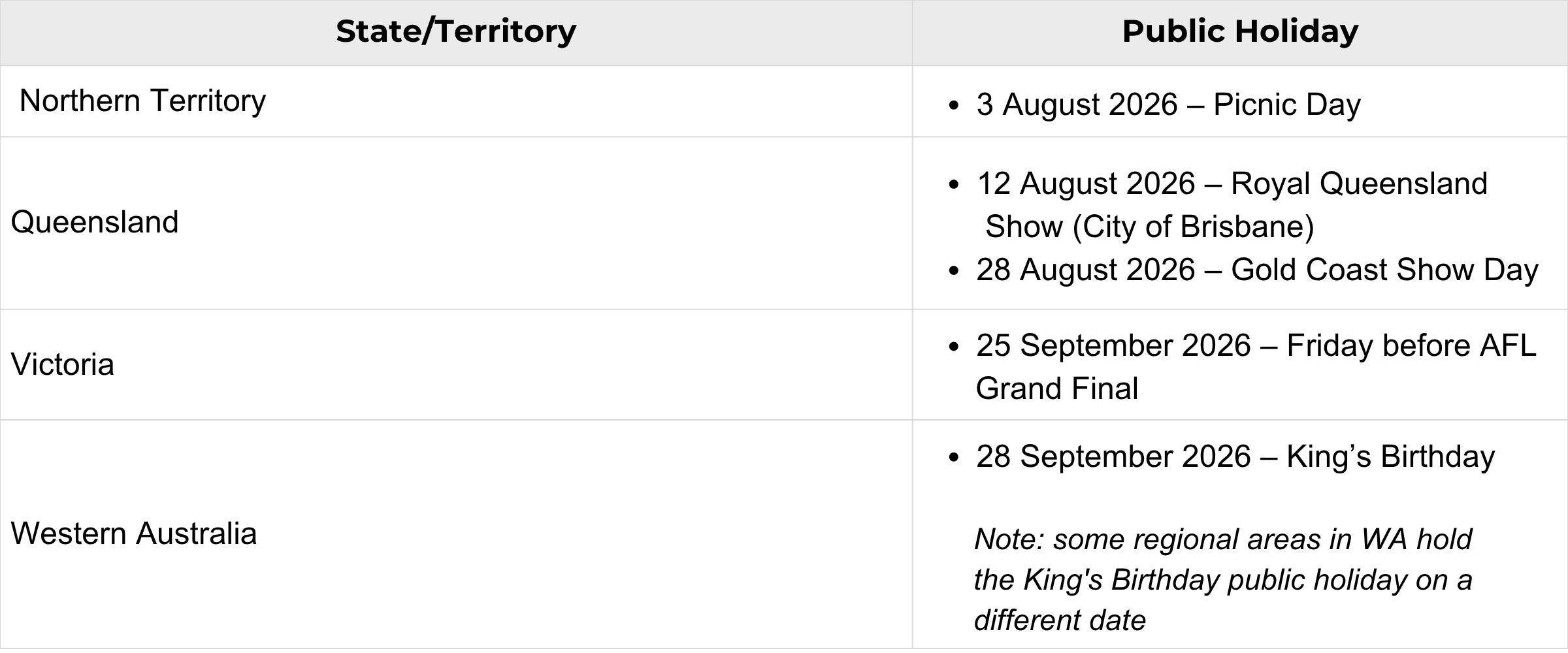
Employers should also ensure they check for any region-specific public holidays, including local show holidays.

The Fair Work Commission (“FWC”) has dismissed an unfair dismissal application brought by Mr Yau Yong Ryan Sim (“Applicant”), a former International Medical Graduate Affairs Coordinator, against Monash Health (“Respondent”), finding that the Applicant was unable to perform the inherent requirements of his role and had repeatedly declined to provide further medical information requested by the Respondent.
BACKGROUND
The Applicant commenced employment with Monash Health on 22 January 2025 as an International Medical Graduate Affairs Coordinator under a maximum-term contract due to expire on 1 March 2026.
Shortly after commencing employment, concerns arose regarding the Applicant’s punctuality, attendance, task completion and overall performance.
In February 2025, the Applicant disclosed that he had ADHD, which he said affected his time management, concentration and productivity. In response, the Respondent implemented a Management Support Plan (“MSP”), which included flexible start times, hybrid work arrangements, mentoring and other supports intended to assist the Applicant in performing his role.
Despite these measures, performance concerns continued. The Applicant subsequently took extended periods of leave and, from May 2025 onwards, was absent from work due to medical issues. Throughout the latter half of 2025, the Applicant provided certificates of capacity stating that he could work only two hours per day, two days per week, in a “non-stressful role“. These restrictions remained effectively unchanged from July to November 2025.
The Respondent repeatedly requested further medical information regarding:
●
the Applicant’s capacity to perform the inherent requirements of his position;
●
the meaning of a “non-stressful role“;
●
reasonable adjustments that could be implemented; and
●
the likely duration of his restrictions.
The Applicant consistently declined to provide any additional medical information beyond his certificates of capacity, which were lacking in detail.
After approximately six months of absence and multiple unsuccessful requests for clarifying medical information, the Respondent commenced a review of the Applicant’s employment. The Applicant was advised that termination was being considered because he could no longer perform the inherent requirements of his position and was invited to provide any further information. He declined to do so. The Respondent subsequently terminated the Applicant’s employment effective 3 December 2025.
THE LAW
Section 385 of the Fair Work Act 2009 (Cth) (“FW Act”) states that a person is unfairly dismissed if:
(a)
the person has been dismissed;
(b)
the dismissal was harsh, unjust or unreasonable;
(c)
the dismissal was not consistent with the Small Business Fair Dismissal Code; and
(d)
the dismissal was not a case of genuine redundancy,
In order to determine if a dismissal was harsh, unjust or unreasonable, section 387 of the FW Act stipulates that the following is to be considered:
●
whether there was a valid reason for the dismissal related to the person’s capacity or conduct (including its effect on the safety and welfare of other employees);
●
whether the person was notified of that reason;
●
whether the person was given an opportunity to respond to any reason related to their capacity or conduct;
●
any unreasonable refusal by the employer to allow the person to have a support person present to assist at any discussions relating to dismissal;
●
if the dismissal related to unsatisfactory performance by the person, whether the person had been warned about that unsatisfactory performance before the dismissal;
●
the degree to which the size of the employer’s enterprise would be likely to impact on the procedures followed in effecting the dismissal;
●
the degree to which the absence of dedicated human resource management specialists or expertise in the enterprise would be likely to impact on the procedures followed in effecting the dismissal; and
●
any other matters that the FWC considers relevant.
THE FINDINGS
Deputy President Masson found that the Applicant’s dismissal was not unfair.
The Commission accepted that, at the time of dismissal, the Applicant’s medical restrictions limited him to four hours of work per week in a “non-stressful role“. Given that the IMG Affairs Coordinator position was a full-time role involving ongoing stakeholder management, time-sensitive work and continual administrative responsibilities, the Applicant could not perform the inherent requirements of the position. The Commission noted that four hours per week represented approximately 10% of the role’s requirements.
Importantly, the Applicant provided no evidence demonstrating that he could perform the inherent requirements of the position either at the time of dismissal or in the foreseeable future. The Commission rejected the argument that the Respondent had improperly extrapolated a long-term incapacity from temporary certificates because:
●
the Applicant had been absent for more than six months;
●
the certificates remained unchanged over an extended period; and
●
the Applicant’s own evidence confirmed that his medical condition continued beyond his dismissal.
The Commission determined that the Applicant’s repeated refusal to provide further medical information was “highly uncooperative”. Deputy President Masson found that the Respondent had requested clarifying information on numerous occasions and could not meaningfully assess reasonable adjustments or alternative duties without further details from the Applicant or his treating practitioner.
The Commission also rejected the Applicant’s argument that the Respondent was required to obtain an Independent Medical Examination (“IME”) before dismissing him. The relevant procedure gave the Respondent the option to seek an IME but did not require one. In the circumstances, the Respondent was entitled to rely on the medical information provided by the Applicant.
In relation to procedural fairness, the Commission found that:
●
the Applicant was clearly notified that dismissal was being considered due to his incapacity;
●
he was given multiple opportunities to provide further information and respond; and
●
the Respondent followed a fair and reasonable process before making its decision.
Accordingly, the Commission concluded that the dismissal was not harsh, unjust or unreasonable.
WHAT THIS MEANS FOR EMPLOYERS
This decision highlights that, depending on the facts of the case, it may be open to employers to lawfully terminate employment where an employee is unable to perform the inherent requirements of their position and there is no reasonable prospect of returning to full duties in the foreseeable future.
Importantly, the decision highlights that capacity management is a shared process. While employers must actively consider reasonable adjustments and obtain appropriate medical information, employees must also cooperate by providing information necessary to assess their work capacity and accommodation needs.
Accordingly, employers should adopt a well-documented approach to managing employee capacity issues, including obtaining and assessing relevant medical information, considering reasonable adjustments, and ensuring procedural fairness before making decisions relating to the employee’s employment.
This decision demonstrates that where an employer genuinely attempts to understand an employee’s capacity and facilitate a return to work but is prevented from doing so by the employee’s refusal to engage in the process, a capacity-based dismissal may be found to be fair.
If you require advice on dismissing an employee for capacity-based reasons, please contact us at info@hrlaw.com.au or one of our experienced solicitors.
To read the case, please see the link below:
https://www.fwc.gov.au/documents/decisionssigned/pdf/2026fwc2633.pdf

Did you know that more than 2.8 million Australians rely on modern award minimum wage rates?
That represents approximately 21.1% of Australia’s workforce, meaning more than one in five employees are directly affected by the Fair Work Commission’s Annual Wage Review.
The modern award-reliant workforce also has some distinctive characteristics:
●
more than 60% are women;
●
over 70% work part-time;
●
more than half are employed on a casual basis; and
●
more than one-third are considered low paid.
While award-reliant employees make up a significant portion of the workforce, their wages account for only 11.2% of Australia’s total wage bill.
As a result, Annual Wage Review decisions have a relatively limited impact on overall national wages growth, but they can have a significant effect on the incomes of lower-paid workers and the businesses that employ them.
The Annual Wage Review therefore remains an important mechanism for balancing the needs of employees who depend on award wage increases with the capacity of employers to absorb rising labour costs.
If you would like advice on any of the matters outlined in our July 2026 Newsletter or need advice on any other workplace matter, please contact our experienced team at info@hrlaw.com.au


Are you following our LinkedIn? For updates on new laws, cases and inquiries as they happen follow us here: https://www.linkedin.com/company/hr-law/
No Comments