


09 Nov HR LAW NEWSLETTER – OCTOBER 2026


In the October 2026 HR Law Newsletter, we discuss the new working-from-home provisions in the Clerks – Private Sector Award 2020, the review of Queensland’s uncommenced Respect at Work reforms, proposed non-compete reforms, and recent Fair Work Commission decisions concerning the misuse of personal leave and extensions of time for general protections claims.
We also examine the Fair Work Commission’s decision in Sydney Night Patrol & Inquiry Co Pty Ltd trading as Certis Security Australia v Sarah El Niz [2026] FWC 3951, which considers whether alternative employment that removed an employee’s established working-from-home arrangements was acceptable for the purpose of reducing redundancy pay.In the October 2026 HR Law Newsletter, we discuss the new working-from-home provisions in the Clerks – Private Sector Award 2020, the review of Queensland’s uncommenced Respect at Work reforms, proposed non-compete reforms, and recent Fair Work Commission decisions concerning the misuse of personal leave and extensions of time for general protections claims.
We also examine the Fair Work Commission’s decision in Sydney Night Patrol & Inquiry Co Pty Ltd trading as Certis Security Australia v Sarah El Niz [2026] FWC 3951, which considers whether alternative employment that removed an employee’s established working-from-home arrangements was acceptable for the purpose of reducing redundancy pay.

1.
Clerks – Private Sector Award 2020 – WFH Changes
New Working from Home Term for the Clerks Award
The Fair Work Commission (“FWC”) have finalised a new working from home term for the Clerks – Private Sector Award 2020 (“Clerks Award”). The new clause 5A, “Requests for working from home arrangements”, commenced on 26 October 2026 and applies to employees from the start of their first full pay period commencing on or after that date.
The Full Bench largely maintained the approach outlined in its earlier August 2026 decision, while making drafting refinements. In particular, an employee’s written request must identify the day or days of the week, or the number, proportion or pattern of days, they propose to work from home. This accommodates arrangements that do not involve fixed home-working days each week.
Under the new term, working from home means performing duties at the employee’s residence or at another location chosen by the employee and approved by the employer. The clause can also be used to document existing working from home arrangements.
A Request Process, Not an Automatic Entitlement
The new term does not create a general entitlement to work from home or require an employer to agree to every request. It establishes a straightforward process through which an individual employee may request, and their employer may agree to, a working from home arrangement.
This process is separate from the statutory right of eligible employees to request flexible working arrangements under the Fair Work Act 2009 (Cth). Employers should therefore identify whether a request is also made under those provisions and ensure that any applicable statutory obligations are met. The new Award term does not replace or diminish those rights.
Documenting an Agreed Arrangement
Where a request is agreed, the arrangement must be documented in writing and made without coercion or duress. The written agreement must set out:
•
the agreed days of the week, or the number, proportion or pattern of days, the employee will work from home;
•
the location from which the employee will work;
•
any Award terms whose application has been modified;
•
any facilitative agreement made under the Award;
•
the arrangement’s start date; and
•
how the arrangement may be varied by agreement or terminated by either party.
The new clause allows the parties to agree to modify how specified Award terms concerning ordinary hours and the timing of rest and meal breaks apply to facilitate working from home. Certain existing Award flexibilities, such as changes to the spread of ordinary hours or shift start and finish times, may also be incorporated through a facilitative agreement. This is not a general permission to disregard other Award requirements.
Finally, employers must retain a copy of the written agreement as a time and wages record and provide a copy to the employee. Disputes about requests may be dealt with under the Clerk Award’s dispute resolution procedure. It is noted that making a request is also a protected workplace right, meaning employers must not take adverse action against an employee because they have made a request.
What This Means for Employers
Employers with employees covered by the Clerks Award should now:
•
review existing working from home arrangements and policies, including whether informal arrangements should be documented under clause 5A;
•
establish a clear process for receiving, assessing and documenting written requests, distinguishing Award requests from statutory flexible working requests;
•
ensure agreed arrangements include all required details and that any modifications remain within the flexibilities permitted by the Award; and
•
keep records of requests and responses, retain agreed arrangements as time and wages records, and give employees a copy of their agreement.
If you would like assistance reviewing your working from home arrangements, responding to requests or ensuring compliance with the Clerks Award, please contact our experienced team at info@hrlaw.com.au.
For further information, please see the FWC’s decision and the Fair Work Ombudsman’s guidance.
2.
Fixed Term Contract Changes from 1 November 2026
From 1 November 2026, changes to the additional fixed term contract exceptions apply to eligible employers and positions in the charities and not-for-profit sector and the medical or health research sector. The changes make the relevant exceptions ongoing rather than temporary and introduce revised funding requirements. They do not create a blanket exemption. The employer, the work and the proposed contract must satisfy all requirements of the relevant exception.
The general fixed term contract limitations introduced on 6 December 2023 continue to apply unless an exception is available. Fixed term contracts generally cannot exceed two years, including extensions or renewals, or provide an option to extend or renew more than once. Certain consecutive contracts for the same or similar work are also restricted where there is substantial continuity of employment.
Revised Funding Test
For contracts entered into on or after 1 November 2026, the revised sector-specific funding test requires more than 50% of the employee’s work to be funded by the sources specified in the relevant exception. Funding from those sources may be counted individually or in combination.
Updated Fixed Term Contract Information Statement
The Fair Work Ombudsman has published an updated Fixed Term Contract Information Statement (“FTCIS”), to access click here.
Employers must ensure that employees entering into fixed term contracts receive the current FTCIS and should retain a record of when it was provided.
What This Means for Employers
Before issuing a fixed term contract, employers should:
•
check its duration, renewal options and any previous consecutive contracts against the applicable limitations;
•
confirm that any exception relied upon satisfies all relevant requirements, including the revised funding test where applicable; and
•
update onboarding materials with the current FTCIS and keep a record of when it was provided. 20261102
The changes do not remove the general fixed term contract limitations that have applied since 6 December 2023.
If you require assistance reviewing fixed term employment arrangements, please contact our experienced team at info@hrlaw.com.au.
3.
Queensland Respect at Work reforms under review
The Respect at Work and Other Matters Amendment Act 2024 (Qld) (“Act”) was passed on 10 September 2024 and received Royal Assent on 19 September 2024. The Act includes significant changes to the Anti-Discrimination Act 1991 (Qld), following the national Respect@Work inquiry and Queensland’s Building Belonging review. However, the main reforms have not yet commenced.
If the reforms commence in their current form, they would:
•
prohibit sex-based harassment and subjecting a person to a work environment that is hostile on the basis of sex. They would also change the tests for direct and indirect discrimination and expand the protected attributes to include potential pregnancy, family, carer or kinship responsibilities, subjection to domestic or family violence, homelessness, physical appearance and certain irrelevant records;
•
introduce a positive duty requiring organisations covered by the Act to take reasonable and proportionate measures to eliminate discrimination, sexual harassment, sex-based harassment and related objectionable conduct, as far as possible. The Queensland Human Rights Commission would have powers to investigate and enforce compliance with the duty, as well as investigate systemic discrimination or harassment; and
•
allow registered employee organisations and other representative bodies to make representative complaints, and extend the ordinary time limit for complaints to the Queensland Human Rights Commission to two years. The representative complaint scheme has already commenced, as outlined below.
Where do the reforms stand?
Some procedural changes, including the representative complaint scheme, commenced on 1 December 2024. However, the main anti-discrimination reforms have not commenced. These include:
•
the positive duty;
•
the prohibitions on sex-based harassment and hostile work environments;
•
the expanded protected attributes;
•
the revised discrimination tests;
•
the two-year complaint period; and
•
the Commission’s broader investigation and enforcement powers.
The main reforms were originally due to commence on 1 July 2025. However, on 14 March 2025, the Queensland Government announced a pause to allow further consultation and policy work.
The Government raised concerns about possible unintended consequences, particularly whether the new “irrelevant criminal record” attribute could affect decisions about weapons licensing, police protection notices and security provider licensing. It also said more time was needed to consult and address these issues without placing an unnecessary compliance burden on organisations.
Legislative amendments passed on 30 April 2025 which removed the scheduled commencement date, leaving the reforms to commence on a date fixed by proclamation (currently, no replacement date has been announced). Presently, the delay reflects a deliberate decision to reconsider the reforms before bringing them into operation, rather than the Act awaiting passage through Parliament.
More recently, the provisions that are yet to commence are being considered as part of the Queensland Government’s review of the State’s human rights and anti-discrimination framework. Public submissions close on 30 October 2026, with the reviewer’s final report due to the Attorney-General by 31 March 2027. Whether these provisions will commence in their current form will depend on the review outcome and the Government’s response.
You can read the full Act here.
For now, employers should continue to comply with existing Queensland anti-discrimination obligations and applicable Commonwealth Respect@Work duties, while monitoring the review outcome and any resulting legislation or proclamation before treating the Queensland provisions yet to commence as being operative.
4.
Non-Compete Reforms – Business Groups Push Back on Proposed Changes
In the 2026 September Newsletter, we discussed the release of draft legislation setting out significant changes to both the Fair Work Act 2009 (Cth) and the Competition and Consumer Act 2010 (Cth) in relation to non-poach and wage-fixing agreements, and non-solicitation and non-compete clauses.
Since the release of the exposure draft of the Competition and Fair Work Legislation Amendment (Banning Unfair Non-Competes) Bill 2026, consultation has now closed and significant concerns have been raised by employer groups regarding the breadth of the proposed reforms.
The draft legislation would:
•
ban non-compete clauses for employees earning at or below the high-income threshold;
•
prohibit co-worker non-solicitation clauses for all employees; and
•
prohibit co-worker non-solicitation clauses for all employees; and
A key concern raised during consultation is that the proposed reforms depart from the long-standing approach under Australian common law, where restraint clauses are assessed on a case-by-case basis to determine whether they are reasonably necessary to protect a legitimate business interest. Stakeholders have argued that the draft legislation replaces that approach with broad statutory prohibitions that may render restraint provisions unenforceable even where they would currently be considered reasonable and enforceable by a court.
Industry groups have also expressed concern about the proposed prohibition on co-worker non-solicitation clauses. Unlike traditional non-compete clauses, these provisions are commonly relied upon to prevent departing employees from recruiting colleagues and causing operational disruption to a business. Some stakeholders have argued that the proposed ban may leave employers vulnerable to coordinated team departures, particularly in industries that rely on specialised skills, client-facing employees or small workforces.
While the legislation remains in draft form and may change before introduction into Parliament, employers should continue reviewing employment contracts, incentive arrangements, workplace policies and template commercial agreements containing restraint provisions. Businesses that have historically relied on non-compete clauses should also consider whether their confidentiality, intellectual property, client protection and other post-employment obligations provide adequate protection if the reforms proceed in their current form. If this is something you require assistance with, please contact us at info@hrlaw.com.au.
As this remains a developing area, we will continue to monitor updates and any amendments to the proposed legislation.
For more information, please see the Bill home page here.
5.
Misuse of Personal Leave Can Constitute Serious Misconduct – Jimmy Parel v Northern Health [2026] FWCFB 254
In Jimmy Parel v Northern Health [2026] FWCFB 254, the Full Bench confirmed that an employee may be validly dismissed for misusing personal leave where their conduct is inconsistent with the purpose for which the leave was taken. The employee, an emergency nurse, took personal leave supported by a medical certificate but was found to have spent the time travelling and campaigning in a union election. The Full Bench upheld the earlier finding that this constituted an improper use of personal leave and refused permission to appeal. The first-instance decision also identified other valid reasons for dismissal, including dishonesty about the campaigning and rude or disrespectful conduct towards other employees.
A significant aspect of the decision is the Full Bench’s rejection of the argument that an employee may engage in any activity while on sick leave provided it is less physically demanding than their normal duties. The Full Bench accepted that employees may undertake activities associated with their illness or recovery, such as attending medical appointments, rehabilitation sessions, or collecting medication. However, it emphasised that personal leave exists to allow employees to manage their illness and recuperate, and there is a reasonable expectation that the leave will be used consistently with that purpose.
The decision reinforces that the issue is not simply what activities an employee undertakes while absent from work, but whether the employee has been honest about their incapacity and use of leave. The Full Bench noted that if the employee genuinely considered himself unfit to perform nursing duties but fit enough to spend his time travelling and campaigning, he could have disclosed this to the employer. Instead, the circumstances supported a finding that the leave was being used for a purpose unrelated to the illness for which it was claimed. The Full Bench confirmed the finding that this amounted to an improper use of personal leave. The observation regarding disclosure concerned the employee’s particular circumstances and credibility and should not be read as a general requirement to disclose every activity undertaken during personal leave.
What This Means for Employers
The decision is a useful reminder that while employers should exercise caution before challenging medical evidence, they may investigate where there is evidence suggesting an employee’s activities during personal leave are inconsistent with their claimed incapacity. The case demonstrates that an employer may have a valid reason for dismissal where the evidence establishes that the employee has used personal leave for purposes unrelated to illness or recovery, particularly where the employee may be being dishonest.
Importantly, the decision does not suggest that employees must remain at home while on personal leave, nor that any activity undertaken during sick leave is misconduct. Rather, the assessment will depend on the nature of the illness, the employee’s claimed incapacity and whether the activity is genuinely consistent with recovery and the purpose of the leave. Employers should therefore focus on the inconsistency between the employee’s stated incapacity and their conduct, rather than simply the fact they were active while absent from work.
To read the decision, please find it here.

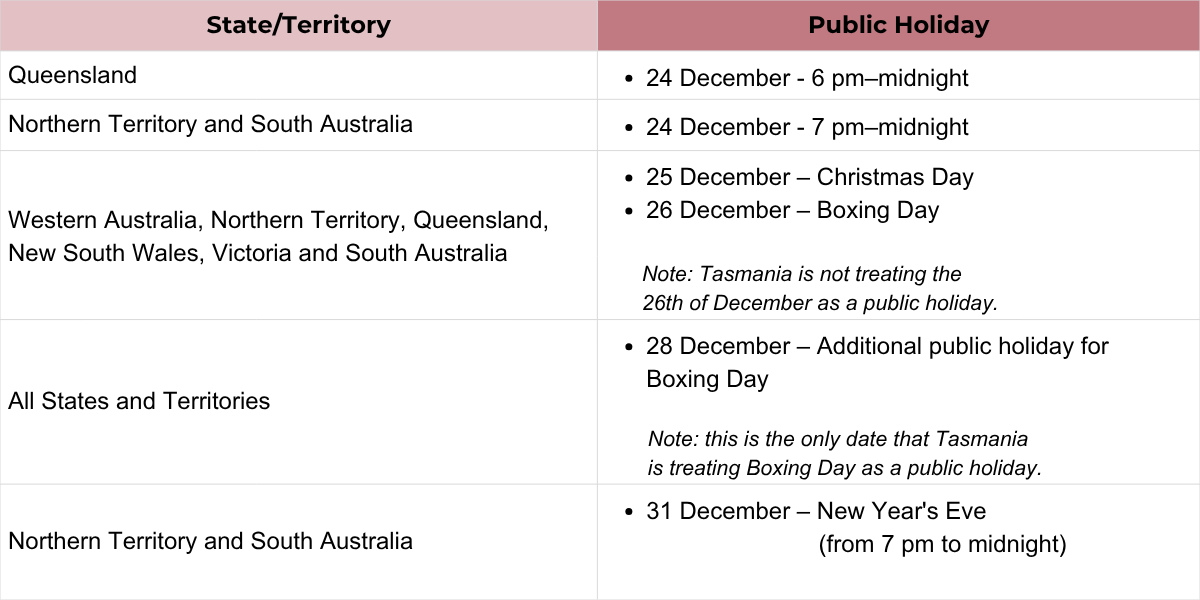
Employers should also ensure they check for any region-specific public holidays, including local show holidays.

OVERVIEW
The Fair Work Commission (“FWC”) dismissed an application by Sydney Night Patrol & Inquiry Co Pty Ltd trading as Certis Security Australia (“the Applicant”) to reduce the redundancy pay owed to Ms Sarah El Niz (“the Respondent”) to nil.
The FWC found that the alternative employment offered to the Respondent was not objectively acceptable. Although the proposed role preserved substantially all her employment conditions, it removed her established work-from-home arrangement and would have required up to four additional hours of travel each day.
BACKGROUND
The Respondent had worked for the Applicant for almost four years as a Roster Liaison Officer. Her position became redundant when the Applicant’s contract with the Port Authority of NSW ended, and her employment concluded on 28 May 2026. The Respondent was otherwise entitled to redundancy pay under section 119 of the Fair Work Act 2009 (Cth) (“FW Act”).
The Applicant offered the Respondent an alternative Workforce Planner position based at its Macquarie Park office. The new role retained the same salary, hours, employment status and seniority, with no other material differences in conditions.
During the first two years of her employment, the Respondent worked between 12 and 14 hours each week at the International Passenger Terminal and completed the remainder of her work from home. For the final two years, she performed all her work from home. She attended the Macquarie Park office only twice during her employment, neither time as part of her normal working arrangements.
Before rejecting the alternative role, the Respondent asked whether her existing flexible or hybrid arrangement could continue. The Applicant confirmed that the offer did not include flexibility. The Respondent maintained that attending the office would involve approximately two hours’ travel each way, additional travel expenses and difficulties associated with her family and school pick-up responsibilities.
The Applicant applied under section 120 of the FW Act to reduce the Respondent’s redundancy entitlement to nil, contending that it had obtained acceptable alternative employment for her.
THE LAW
Section 119 of the FW Act establishes an employee’s entitlement to redundancy pay.
Under section 120, the FWC may reduce that entitlement, potentially to nil, where the employer obtains other acceptable employment for the employee.
Whether alternative employment is acceptable is assessed objectively, having regard to the characteristics of the employment and the employee’s individual circumstances. Relevant considerations may include the nature and location of the work, travel requirements, remuneration, hours, seniority, benefits, workload, job security, skills and experience. The employer bears the evidentiary burden of establishing that the alternative employment is acceptable.
Alternative employment need not be identical or more advantageous. However, it must be sufficiently comparable to the former employment and not place the employee in materially more precarious circumstances.
THE FINDINGS
Deputy President Easton found that the Applicant had not obtained acceptable alternative employment for the Respondent.
The FWC accepted that the Applicant had preserved substantially all the Respondent’s terms and conditions apart from the location where the work would be performed. However, the practical reality was that the Respondent had worked entirely from home for the previous two years, and the alternative role provided no guarantee that she could continue working from home to any extent.
The Applicant submitted that the new workplace involved only a five-minute variation from the Respondent’s existing principal place of work. The FWC rejected that assessment because the Applicant had not explained its calculation and appeared to rely on either the passenger terminal or the Macquarie Park office as the comparator, when neither reflected the Respondent’s actual working arrangements.
The FWC accepted that the alternative role would require up to four additional hours of travel each day. When considered together with the Respondent’s family responsibilities, this substantial commuting requirement meant that the role was not objectively acceptable.
Although the FWC recognised that the Applicant had attempted to avoid the adverse consequences of redundancy by offering another role, the alternative position did not wholly or partially avoid the hardship arising from redundancy. The Applicant’s application to reduce the Respondent’s redundancy pay was therefore dismissed.
WHAT THIS MEANS FOR EMPLOYERS
This decision demonstrates that the acceptability of alternative employment does not depend solely on whether salary, status, hours and other contractual conditions are preserved. The FWC may also consider an employee’s actual working arrangements and the practical effect of changing them.
Where an employee has worked remotely for a substantial period, requiring regular office attendance may materially change the employment even if working from home was not formally recorded as a contractual entitlement.
Employers seeking to rely on section 120 should assess alternative employment in light of the affected employee’s individual circumstances and obtain clear evidence about commuting time, costs, caring responsibilities and other practical consequences. Any comparison should reflect the employee’s actual former place and pattern of work rather than merely the workplace identified in their contract.
Employers should also engage meaningfully with requests for hybrid or flexible arrangements when proposing redeployment. Where flexibility cannot be offered, the reasons should be clearly explained and documented.
If you require advice regarding redundancies, redeployment or applications to vary redundancy pay, please contact us at info@hrlaw.com.au or one of our experienced solicitors.
To read the Decision and Order, please click here.

Recent research by the Working for Women Research Partnership has highlighted that not all flexible working arrangements provide the same benefits for employees or employers.
In its report, Good Flex, Bad Flex: Designing Flexibility for Gender Equality, the Partnership report, distinguishes between “good flex” and “bad flex”.
“Good flex” provides employees with genuine choice and control over their working hours, patterns or location, while supporting job security and opportunities for career progression.
“Bad flex” provides employees with less control and is more likely to be associated with reduced hours, insecure work or tightly controlled working arrangements.
The research highlights that well-designed flexible work can benefit both employees and employers. For employers, access to effective flexible working arrangements can contribute to higher employee retention, productivity and sustained workforce participation.
The findings are a useful reminder for employers that flexibility is not simply about whether flexible working arrangements are available, but how those arrangements are designed and supported in practice.
Employers should consider whether their flexible working practices provide employees with meaningful flexibility while continuing to meet the operational requirements of the business.
If you would like advice on flexible working arrangements, responding to flexible work requests or reviewing your workplace policies, please contact our experienced team at info@hrlaw.com.au.
To read the Working for Women Research Partnership’s full report, Good Flex, Bad Flex: Designing Flexibility for Gender Equality, please see the report here.
If you would like advice on any of the matters outlined in our October 2026 Newsletter or need advice on any other workplace matter, please contact our experienced team at info@hrlaw.com.au

Are you following our LinkedIn? For updates on new laws, cases and inquiries as they happen follow us here: https://www.linkedin.com/company/hr-law/
No Comments