


02 Sep HR LAW NEWSLETTER – AUGUST 2026

In the August 2026 HR Law Newsletter, we discuss the increasing use of artificial intelligence in workplace relations, including new Fair Work Commission requirements for parties using generative AI in proceedings and a landmark costs decision involving AI-generated submissions.
We also examine the risks associated with uploading legal advice and confidential workplace information to public AI platforms, recent working from home developments under the Clerks – Private Sector Award 2020, temporary increases to vehicle allowances under the SCHADS and Aged Care Awards, and the key findings of the Closing Loopholes Review.
In addition, we provide a case brief on a significant Full Bench decision clarifying when a dismissal will constitute a genuine redundancy.
Before You Upload Legal Advice or Confidential Information to Public AI Platforms, Think Twice
Artificial intelligence is rapidly changing the way businesses operate, and many organisations are now using AI tools to draft documents, summarise information, prepare meeting notes and answer workplace relations questions.
While AI can be a useful productivity tool, recent legal developments highlight an important risk, using public AI platforms to summarise legal advice or confidential workplace information may jeopardise legal professional privilege and confidentiality protections.
Legal professional privilege allows employers to seek legal advice confidentially and, in many circumstances, prevents that advice from being disclosed in litigation, regulatory investigations or other legal proceedings. However, privilege depends on confidentiality. Uploading legal advice, draft responses, board papers, investigation materials or workplace documents to public AI tools may create a risk that confidentiality is lost and privilege is waived.
A recent 2026 United States court decision, United States v Heppner, highlights the risks of uploading sensitive legal information into public AI tools. The defendant used a free AI platform to organise and analyse information relating to his legal defence before sharing it with his lawyers. When the documents were later sought by prosecutors, his lawyers tried to argue they were protected by legal professional privilege. The court disagreed, finding that by uploading the material to the AI platform, he had effectively disclosed it to a third party and lost the confidentiality required for privilege to apply. Further, the court referred to the AI platform’s terms, which stated that users’ inputs were not confidential and that there should be no expectation of privacy when inputting information. Although this is a United States decision and is not binding in Australia, it illustrates the risk that providing privileged or confidential material to a third-party AI platform may undermine the confidentiality necessary to maintain privilege. Whether privilege is lost or waived under Australian law will depend on the particular circumstances, including the platform’s terms of use, security arrangements and how the information may be accessed, retained or used.
We also remind employers that AI remains susceptible to “hallucinations” and can produce inaccurate legal authorities, outdated legislative references, or advice that appears convincing but is legally incorrect. In employment law, relying on inaccurate information, as we discuss further in this newsletter, can expose parties to costs, penalties and reputational damage.
As AI becomes more prevalent in the workplace, businesses should think carefully before uploading legal advice, confidential employee information or sensitive workplace documents into public AI tools. When in doubt, seek legal advice first.
If you are unsure whether a proposed use of AI could affect confidentiality or privilege, contact the HR Law team.

1.
Use of AI in the Fair Work Commission – President’s Statement
On 24 August 2026, President Justice Adam Hatcher of the Fair Work Commission (“Commission”) published a statement announcing the release of the Commission’s new Guidance Note: Use of generative artificial intelligence in Commission cases.
The Guidance Note will apply from 20 October 2026 and sets out practical requirements for parties who use generative AI to prepare applications, submissions, witness statements or any other documents to be lodged in Commission proceedings.
In summary, where GenAI is used to prepare documents in Commission proceedings, parties will be required to:
•
disclose when and how GenAI has been used;
•
check the document and make any necessary changes to ensure that its contents are correct and relevant, including verifying that any facts, evidence and legal authorities referred to exist and support the propositions for which they are cited;
•
where the document is a witness statement or declaration, a party must ensure that it reflects the witness’ own knowledge and words and is true to the best of their knowledge.
The Commission has also indicated that legal practitioners and other professional representatives must include hyperlinks to any case law cited in documents prepared using GenAI.
The Guidance Note reflects a broader shift in how workplace disputes are being prepared and presented. While GenAI may assist parties to organise information, draft documents and better understand the Commission process, it also creates risks where parties rely on AI-generated material without properly checking its accuracy. Those risks include misstated facts, incorrect legal propositions, fabricated authorities, inappropriate disclosure of confidential information and witness evidence that does not properly reflect the witness’ own recollection.
The increased use of GenAI is likely to change the way Commission matters are managed, particularly in unfair dismissal, general protections and other individual employment claims. Employers may see more detailed or legally framed applications from self-represented applicants, but those documents may not always be accurate or properly supported. This may require employers to more carefully scrutinise applications, submissions and evidence for inaccuracies, unsupported allegations, incorrect legal references and signs that AI-generated content has been used without proper verification.
Accordingly, employers and HR teams should ensure that any use of GenAI in Commission matters is carefully supervised, checked and disclosed in accordance with the new requirements. In practice, employers should:
•
maintain clear internal processes for the use of AI in workplace disputes;
•
ensure documents are reviewed by an appropriate person before filing;
•
protect confidential and personal information;
•
make sure witness statements remain accurate, personal and based on the witness’ own knowledge; and
•
be prepared to challenge AI-generated material where it appears inaccurate, irrelevant or unsupported by evidence.
2.
Clerks Award – Working from Home Decision
On 27 August 2026, the Commission issued its decision in the Working from home – Clerks – Private Sector Award 2020 major case (AM2024/34). The Full Bench has decided to vary the Clerks – Private Sector Award 2020 (“Clerks Award”) to include a new working from home term, with a draft determination now published for comment. The proposed term is not yet operative and the final wording and commencement arrangements will be confirmed after the Commission has considered submissions on the draft determination.
In practical terms, the proposed new term is intended to give employers and employees a clearer framework for managing working from home arrangements where employees are covered by the Clerks Award. It contemplates a process for employees to request working from home arrangements and for the parties to agree, in writing, how certain Award obligations will apply when work is performed remotely.
Importantly, the proposed changes do not create a broad or automatic right for Clerks Award employees to work from home. The changes instead recognise the practical reality that hybrid and remote work arrangements are now common in clerical and administrative roles, while seeking to ensure those arrangements remain consistent with the Award framework, including ordinary hours, breaks, minimum engagement requirements, allowances and record-keeping obligations.
The changes will also sit alongside, rather than replace, the existing flexible working arrangement provisions under the Fair Work Act 2009 (Cth). This means employers will need to continue considering whether an employee has a separate statutory entitlement to request flexible working arrangements, while also ensuring that any agreed working from home arrangement complies with the Clerks Award once the new term is finalised.
Submissions concerning drafting or other technical issues arising from the draft determination are due by 5:00 pm (AEST) on Thursday, 17 September 2026.
For employers, this is a timely reminder to review current working from home and hybrid work arrangements for Clerks Award-covered employees. In particular, employers should check whether:
•
working from home arrangements are clearly agreed and recorded;
•
ordinary hours and breaks are being managed appropriately;
•
time and attendance records are sufficient;
•
any Award-based entitlements are affected when work is performed away from the workplace; and
•
existing working from home policies, individual agreements and payroll or time-recording practices are likely to remain appropriate if and when the proposed Award term takes effect.
3.
FWC Temporarily Increases Vehicle Allowances in Social, Community, Home Care and Disability Services and Aged Care Awards
The Fair Work Commission has granted a temporary increase to the motor vehicle allowances payable under the Social, Community, Home Care and Disability Services Award 2010 and the Aged Care Award 2010, in response to increased fuel costs arising from recent global events.
From the first full pay period commencing on or afte r 1 September 2026, the applicable vehicle allowance under those Awards will increase by 4 cents per kilometre from $1.01 to $1.05 per kilometre and will remain in effect until 28 February 2027.
Employers covered by these Awards should update payroll systems and any internal documents that record the kilometre rate, while noting that the applicable rate after 28 February 2027 will depend on the Award provisions then in force.
4.
Closing Loopholes Review Recommends Further Workplace Relations Reforms
The final report of the independent review of the Federal Government’s Closing Loopholes reforms, conducted by former Fair Work Commission member Susan Booth, has recommended a range of further changes to Australia’s workplace relations framework.
Key recommendations include:
•
expanding paid family and domestic violence leave to cover circumstances involving extended family members and cultural kinship relationships;
•
clarifying the evidence employers may request when employees access paid family and domestic violence leave;
•
considering whether the employee-like worker framework should be extended to additional groups of contractors such as journalists, performers, musicians, writers and translators;
•
greater oversight of wage theft enforcement by making the Fair Work Ombudsman report on its activities relating to wage theft and civil remedies for underpayment; and
•
further reviews of several major reforms introduced under the Closing Loopholes legislation, including the right to disconnect, labour hire arrangements, employee-like work provisions and the wage theft offence.
While the report does not itself change the law, it is likely to influence future workplace relations policy and reform discussions.
5.
FWC Issues Costs Order in AI-Assisted Unfair Dismissal Claim
In Sadnan Khan v Aldi Pty Ltd [2026] FWC 3144, the Fair Work Commission (“Commission”) made what is believed to be one of the first costs orders arising from a party’s unreasonable reliance on AI-generated submissions.
Mr Khan, a former Aldi employee, was ordered to pay $1,230 towards Aldi’s legal costs after pursuing an unfair dismissal application that had no reasonable prospects of success.
Mr Khan had not been employed for the statutory minimum employment period of six months, meaning he was not eligible to lodge an unfair dismissal claim.
Despite receiving multiple warnings from the Commission that his claim was jurisdictionally defective, the Mr Khan continued to rely on AI-generated submissions which incorrectly asserted when his employment ceased.
While confirming that artificial intelligence can be a useful drafting tool, the Commission emphasised that parties remain responsible for reviewing and understanding the material they submit, and that reliance on AI does not excuse unreasonable conduct in litigation.
To read more about the case, please find the decision here:

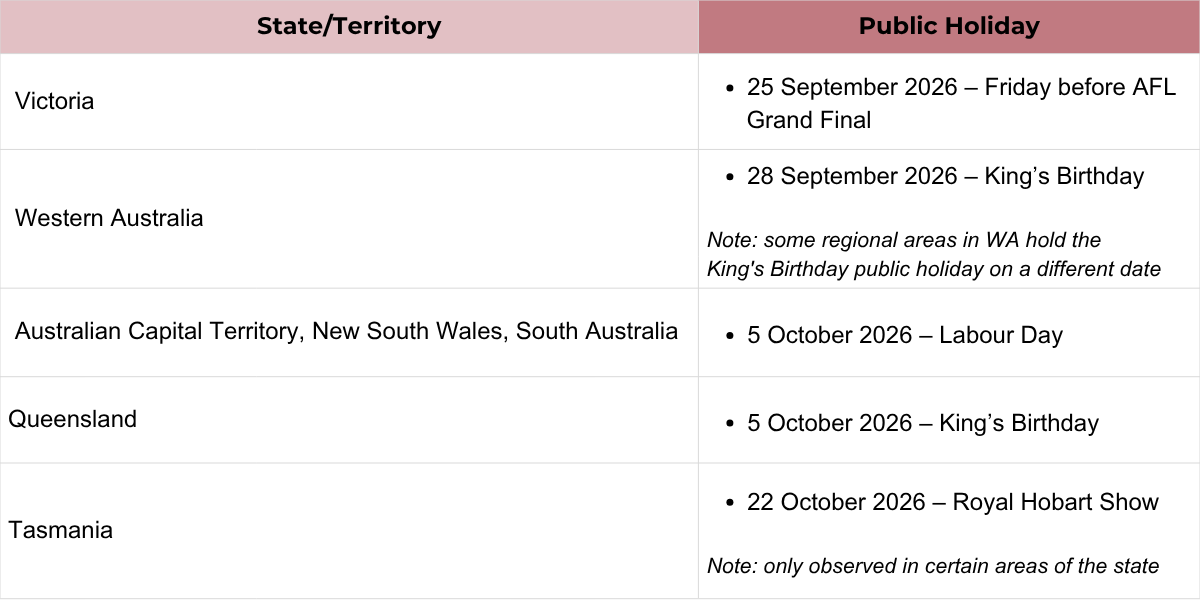
Employers should also ensure they check for any region-specific public holidays, including local show holidays.

The Full Bench of the Commission has overturned a decision that the dismissal of a Head Coach was a case of genuine redundancy, finding that an employer cannot make a position redundant merely because it no longer wishes, or is unable,
to pay the existing salary where the same job and duties continue to be required
BACKGROUND
The Applicant commenced employment with Tuggeranong Vikings Swim Club Inc (“Respondent”) as its Head Coach in April 2024. During his employment, a newly elected committee undertook a review of the Respondent’s financial position and concluded that the organisation could no longer sustain the salary attached to the Head Coach position.
As part of that process, the Respondent proposed that the Applicant continue in the Head Coach role but at a substantially reduced salary. The proposed remuneration represented a significant reduction from the Applicant’s existing annual salary. The Applicant did not agree to the proposed change.
The Respondent subsequently terminated the Applicant’s employment and characterised the termination as a redundancy. Following the termination, the coaching functions previously undertaken by the Applicant continued to be performed within the organisation through alternative staffing arrangements.
The Applicant commenced unfair dismissal proceedings in the Fair Work Commission, contending that his dismissal was not a case of genuine redundancy because the work he had previously performed continued to be required by the Respondent. At first instance, the Commission found that the dismissal was a genuine redundancy and dismissed the application. The Applicant subsequently appealed that decision to a Full Bench of the Commission.
THE LAW
Section 385 of the Fair Work Act 2009 (Cth) (“FW Act”) provides that a person has been unfairly dismissed if:
- the person has been dismissed;
- the dismissal was harsh, unjust or unreasonable;
- the dismissal was not consistent with the Small Business Fair Dismissal Code; and
- the dismissal was not a case of genuine redundancy.
Section 389 of the FW Act provides that a dismissal will be a case of genuine redundancy where:
- the employer no longer requires the employee’s job to be performed by anyone because of changes in the operational requirements of the employer’s enterprise;
- the employer has complied with any applicable consultation obligations under a modern award or enterprise agreement; and
- it would not have been reasonable in the circumstances to redeploy the employee within the employer’s enterprise or the enterprise of an associated entity.
In determining whether a dismissal is a genuine redundancy, the Commission must consider whether the employer no longer requires the employee’s job to be performed by anyone because of changes in the operational requirements of the enterprise. The focus is not simply on the employer’s financial position or a desire to reduce salary costs, but on whether, following any restructure or reorganisation, there are any duties left for the employee’s job to discharge.
THE FINDINGS
The Full Bench allowed the appeal and concluded that the Applicant’s dismissal was not a case of genuine redundancy. In reaching that conclusion, the Full Bench found that the first instance decision had misapplied the statutory test by focusing on the Respondent’s financial position, rather than asking whether the Head Coach role itself was no longer required to be performed by anyone for the purposes of section 389(1)(a) of the FW Act.
The Full Bench accepted that the Respondent had genuine financial concerns and had sought to reduce labour costs. However, the Commission found that a decision to reduce the remuneration associated with a position does not necessarily mean that the underlying job is no longer required to be performed.
The Full Bench considered that the critical question was whether, after the reorganisation, the Applicant would have any duties left to perform. On the facts, the answer was yes. The functions and duties to be performed after the proposed reduction in pay were the same functions and duties the Applicant had been required to perform before the reduction. As those duties continued to be required, the Head Coach position had not become redundant.
The Respondent argued that, following the dismissal, it did not employ new coaching staff and instead relied on volunteers and casuals. However, the Full Bench treated that arrangement as an interim measure arising from the Applicant’s refusal to accept the lower salary. It was not the reason for the dismissal and did not establish that the Head Coach role had ceased to be required.
Accordingly, the Full Bench found that the dismissal did not satisfy the statutory requirements for a genuine redundancy. The appeal was upheld, the original decision was set aside, and the matter was referred to another Member of the Commission to determine the Applicant’s unfair dismissal application. The Full Bench observed that the Respondent’s financial circumstances may still be relevant when assessing whether the dismissal was harsh, unjust or unreasonable and when considering any remedy. However, those considerations were separate from the question of whether the dismissal constituted a genuine redundancy.
WHAT THIS MEANS FOR EMPLOYERS
This decision highlights that a reduction in remuneration will not necessarily constitute a genuine redundancy where the employer continues to require substantially the same work to be performed.
Employers should carefully consider whether the employee’s job has genuinely ceased to be required as a result of operational changes, rather than focusing solely on changes to salary or other employment conditions.
Accordingly, the following practical steps for employers are recommended:
- before implementing a redundancy, assess whether the work previously performed by the employee will genuinely cease or whether it will continue to be performed within the business in some form; and
- where cost-saving measures involve proposed reductions to remuneration or other terms and conditions of employment, consult with affected employees and ensure the proposed changes are not incorrectly characterised as a redundancy.
If you require advice on unfair dismissals or redundancies, please contact us at info@hrlaw.com.au or one of our experienced solicitors.
To read the case, please see the link below:

The Fair Work Commission (“Commission”) recently revealed that around 40% of surveyed applicants reported using artificial intelligence (“AI”) tools to help prepare and manage their cases.
Among those respondents, ChatGPT was the most commonly used platform, with 77% of surveyed applicants relying on it.
Among those most likely to rely on AI are self-represented parties, employees under 44 years of age, and professional or managerial workers.
Fair Work Commission President, Justice Hatcher, has attributed the 70% increase in the Commission’s workload over the past three years to the rapid growth in the use of AI.
If you would like advice on any of the matters outlined in our August 2026 Newsletter or need advice on any other workplace matter, please contact our experienced team at info@hrlaw.com.au


Are you following our LinkedIn? For updates on new laws, cases and inquiries as they happen follow us here: https://www.linkedin.com/company/hr-law/
No Comments