


02 Jul HR LAW NEWSLETTER – JUNE 2026


In the June 2026 HR Law Newsletter, we discuss upcoming amended legislation enforcement dates relating to Payday Super and the advertisement of superannuation products, key developments in Queensland anti-discrimination and human rights reforms, Victoria’s proposed right to work from home, and significant changes to the SCHADS Award.
In the June 2026 HR Law Newsletter, we discuss upcoming amended legislation enforcement dates relating to Payday Super and the advertisement of superannuation products, key developments in Queensland anti-discrimination and human rights reforms, Victoria’s proposed right to work from home, and significant changes to the SCHADS Award.
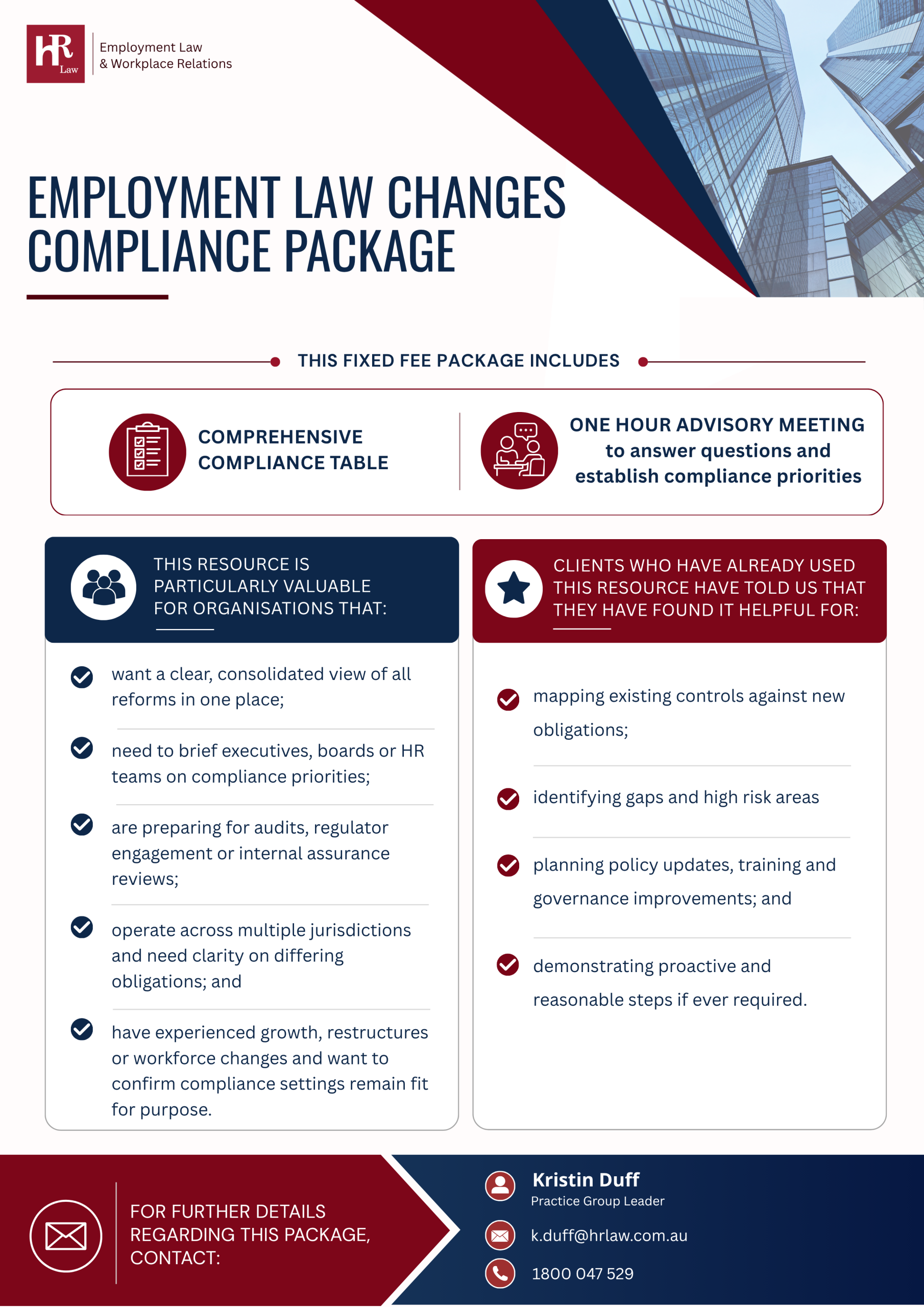
HR Law’s Employment Law Changes Compliance Package
Over the past four years, the scale and pace of industrial relations and employment law reforms in Australian have been significant.
Keeping up with these changes is not getting any easier and for many organisations the real challenge is knowing what has changed, what applies to them and what to prioritise.
HR Law’s Employment Law Changes Compliance Package is designed to provide clarity and direction. Our comprehensive table summarises the key industrial relations and employment law changes since 2022, together with the required compliance actions. The table is designed to operate as a practical, auditable compliance tool.
This resource is a must-have for the new financial year.
For more information, please contact our Practice Group Leader, Kristin Duff, at k.duff@hrlaw.com.au or 1800 047 529.

1.
Upcoming Amended Legislation Enforcement Dates
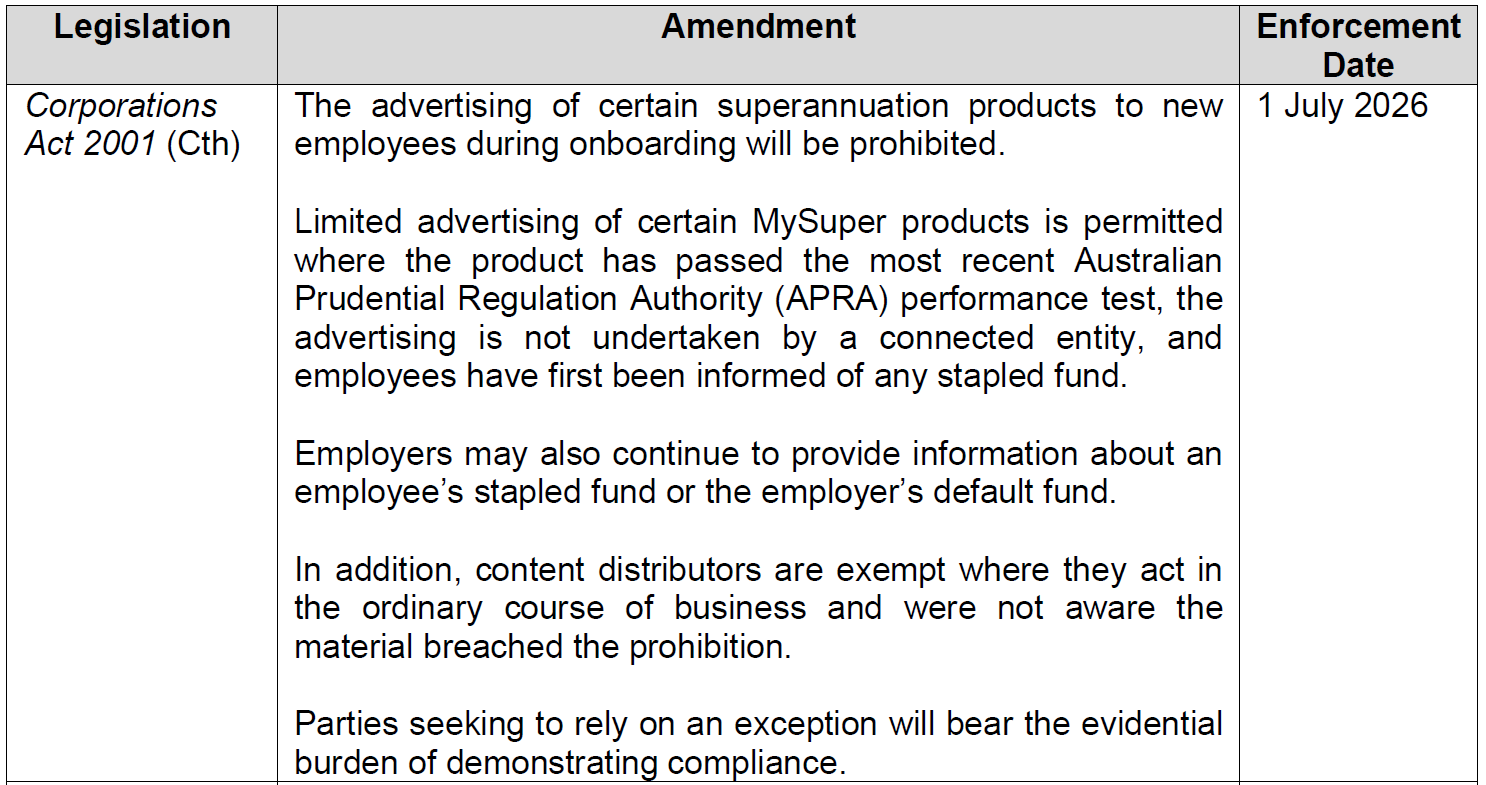
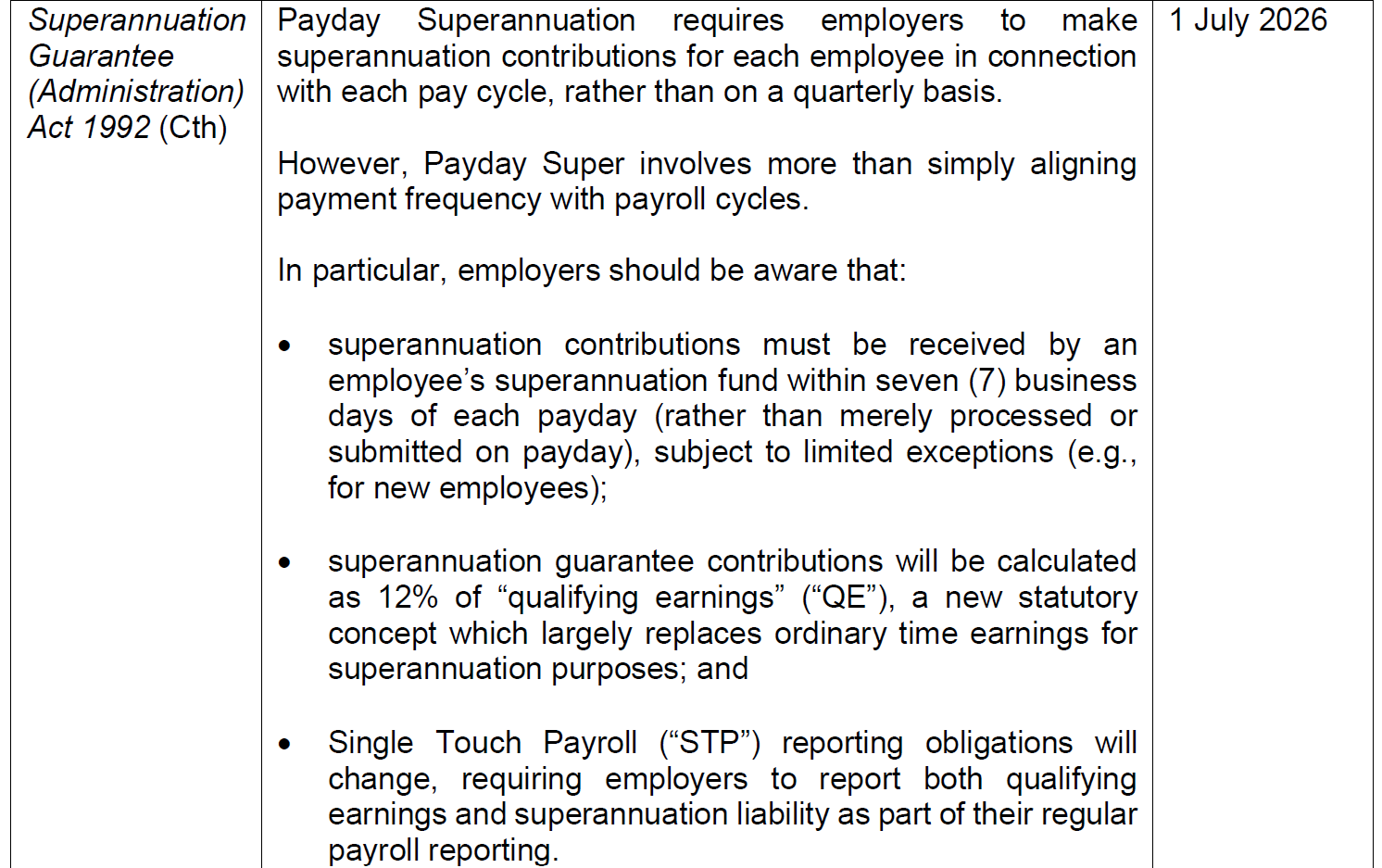
We remind employers of the following upcoming dates regarding the enforcement of amendment legislation:


2.
Review of Queensland Anti-Discrimination and Human Rights Legislation
The review of the Queensland Respect at Work Anti-Discrimination Changes has recommenced in late June 2026 after it was paused in March 2025, with the review report due on 31 March 2027.
The terms of reference include:
•
Review of Queensland Anti-Discrimin• considering the potential operation of the Respect at Work and Other Matters Amendment Act 2024 (Qld) and making recommendations concerning the operation of and reform to the Anti-Discrimination Act 1991 (Qld);ation and Human Rights Legislation
•
a strategic review of the Queensland Human Rights Commission’s functions and performance of its functions to assess whether they are being performed economically, effectively and efficiently; and
•
further independent review of the Human Rights Act 2019 (Qld) (“Human Rights Act”) to determine if any additional human rights should be included, whether changes are needed to proceedings or remedies relating to acts or decisions of public entities rendered unlawful under the Human Rights Act and whether the amendments to the Corrective Services Act 2006 (Qld) and Youth Justice Act 1992 (Qld) are operating effectively, or require adjustment to better align with the Human Rights Act.
To read more about the terms of reference please see the link below:
https://www.justice.qld.gov.au/__data/assets/pdf_file/0004/907636/tor-hrc.pdf
3.
Victoria’s introduction of the Equal Opportunity Amendment (Work from Home) Bill 2026
The Victorian Government introduced the Equal Opportunity Amendment (Work from Home) Bill 2026 (“the Bill”) on 16 June 2026 to introduce a right to work from home for two (2) days per week (“the Right”).
If the Bill is passed, the Right will apply to workplaces:
•
with more than fifteen (15) employees from 1 September 2026; and
•
with fewer than fifteen (15) employees from 1 July 2027.
The Right will apply to all employees apart from those on probation, irregular casuals, employees undertaking an apprenticeship, training, internship, graduate program, workplace experience or similar, and regulated workers as defined by the Fair Work Act 2009 (Cth).
The Bill has not specified how the Right will be pro-rated for part-time employees. However, it is anticipated that this will be set out in regulations.
An employer who receives a work from home notice from an employee has twenty-one (21) days to respond and must grant the request unless it is not reasonable to do so. Factors relevant to whether a refusal is reasonable include:
•
the inherent requirements of the employee’s role, including whether the requirements can be satisfied without the employee attending the workplace on certain days and times, without the use of equipment kept at the workplace and without in-person interaction with clients or members of the public;
•
the impact that the employee working from home will have on the employer, including:
○
whether it is likely to cause a significant decrease in productivity or efficiency;
○
would have an adverse impact on any person’s safety;
○
would have a significant adverse impact on supervision, training or professional development of other employees;
○
would have a significant adverse impact on the ability to build relationships between the employee and stakeholders (i.e. clients);
○
would have significant adverse impact on customer service outcomes, confidentiality or data protections;
○
would impose financial cost on the employer that are excessive; or
○
would require the employer to make changes to the working arrangements of the employee or any other employee or require hiring of new employees that are impractical.
The Bill also outlines dispute resolution processes for enforcing the right through conciliations being heard by the Victorian Equal Opportunity and Human Rights Commission or Victorian Civil and Administrative Tribunal (“VCAT”). If conciliation is unsuccessful, the matter will proceed to a hearing at VCAT.
Other notable aspects include:
•
that an employer must pay any reasonable costs necessary to enable the employee to work from home, including hardware, software and anything required to give the employee secure access to the employer’s information system; and
•
VCAT can order an employer to pay an employee an amount that it sees fit to compensate the employee for loss, damage or injury suffered due to a contravention of the legislation, including where a notice to work from home has been rejected.
To read more about the Bill, please see the link to the Bill Home Page below:
https://www.legislation.vic.gov.au/bills/equal-opportunity-amendment-work-home-bill-2026
4.
Changes to the Social, Community, Home Care and Disability Services Award 2010
From October 2027, employees and workers covered by the Social, Community, Home Care and Disability Services Award 2010 (“SCHADS Award”) will receive up to a 27% pay rise.
The expert panel determined that a single classification structure was necessary to rectify gender-based undervaluation.
These changes are part of the FWC’s Gender-based undervaluation – priority awards review, a broader reform process aimed at addressing historical undervaluation in female‑dominated industries.
These changes and pay rises will be enforced from October 2027. However, for disability support workers it will be enforced from 1 October 2027.
To read more about the changes to the SCHADS Award, read the decision below:
https://www.fwc.gov.au/documents/decisionssigned/pdf/2026fwcfb137.pdf


Employers should also ensure they check for any region-specific public holidays, including local show holidays.

The Fair Work Commission (“FWC”) has criticised the operator of Melbourne’s rail network, Metro Trains (“the Respondent”), following a finding that its handling of a sexual harassment complaint did not comply with its Enterprise Agreement obligations.
The decision highlights serious deficiencies in the Respondent’s processes, including a lack of clarity over responsibility for complaints, delays in investigation and a failure to demonstrate an understanding of its legal obligations under the Sex Discrimination Act 1984 (Cth) (“Sex Discrimination Act”) and the positive duty framework.
BACKGROUND
The Rail, Tram and Bus Union (“the Applicant”) asked the FWC to arbitrate a dispute concerning whether the Respondent had complied with its Enterprise Agreement (“EA”) when handling an employee’s complaint of sexual harassment and victimisation.
The employee (referred to as AX) raised six (6) allegations of sexual harassment against a colleague (referred to as BX) on 19 November 2024. However, the formal investigation was not confirmed until 23 May 2025, more than five (5) months later, and the allegations were not put to BX until around October 2025, approximately eleven (11) months after the complaint was first raised.
At the time of the FWC hearing on 11 December 2025, the victimisation investigation remained ongoing. This meant the FWC was considering a process that had extended for more than a year from the first complaint, with key investigative steps still incomplete.
THE LAW
Under section 28A of the Sex Discrimination Act, sexual harassment occurs where a person makes an unwelcome sexual advance, an unwelcome request for sexual favours, or engages in other unwelcome conduct of a sexual nature, in circumstances where a reasonable person would have anticipated the possibility that the person harassed would be offended, humiliated or intimidated.
The Sex Discrimination Act makes sexual harassment unlawful in a range of work-related contexts, including by employers, employees, workers and agents. It also prohibits conduct that creates a workplace environment that is hostile on the ground of sex, as well as victimisation connected to complaints, allegations or proceedings about unlawful sex discrimination or sexual harassment.
Importantly, section 47C of the Sex Discrimination Act imposes a positive duty on employers and persons conducting a business or undertaking (“PCBUs”) to take reasonable and proportionate measures to eliminate, as far as possible, relevant unlawful conduct. This includes sexual harassment, sex-based harassment, hostile workplace environments and related acts of victimisation.
The Respondent argued that its obligations were limited to taking steps that were “reasonably practicable” in accordance with its EA. Clause 2.03 of the Respondent’s EA required them, inter alia, to:
•
treat all incidents and complaints of sexual harassment “seriously and in confidence”;
•
promptly investigate allegations; and
•
ensure that complainants are not victimised.
However, Commissioner Fox rejected this position, finding that the clause instead required compliance with relevant legislation, including the Sex Discrimination Act, and the positive duty to eliminate sexual harassment.
THE FINDINGS
In this matter, the FWC’s role was limited to determining compliance and making findings, rather than imposing penalties.
In particular, Commissioner Fox concluded that the Respondent had not complied with its EA obligations and identified a number of significant issues with the Respondent’s approach. In particular, the evidence suggested that there was a lack of clear Human Resources (“HR”) oversight and accountability, where two (2) HR representatives of the Respondent were unable to identify whether the Respondent had a sexual harassment policy, who was responsible for managing the complaint or what decisions had been made and by whom.
The FWC was also critical of the delays in the Respondent’s response. The investigation did not commence until five (5) months after the complaint was formalised, the allegations were not put to BX until eleven (11) months after the complaint was formalised and the victimisation allegations remained unresolved at the time of the hearing.
Commissioner Fox ultimately described the Respondent’s handling as demonstrating a “distinct lack of understanding” of its legal obligations.
WHAT THIS MEANS FOR EMPLOYERS
This decision is an important reminder that employers must take a structured and proactive approach to sexual harassment complaints. Employers cannot rely on a lower “reasonably practicable” standard where legislative obligations, including the positive duty under the Sex Discrimination Act, require more.
In practical terms, employers should ensure complaints are triaged early, managed promptly, responsibility for decision-making is clear and each step taken is properly documented. Policies must also be understood and capable of being applied by HR, managers and senior leaders, rather than existing only as written documents.
Employers should also take steps to manage risk as soon as allegations are raised. This may include conducting a risk assessment, considering temporary separation of the parties, or implementing other safeguards while the complaint is investigated. Procedural fairness remains important, but it should not be used as a reason for delay or inaction.
Accordingly, the following practical steps for employers are recommended:
•
reviewing sexual harassment and complaint handling policies;
•
ensuring HR, managers and senior leaders understand their roles and obligations;
•
documenting who is responsible for key decisions; and
•
providing regular training on the positive duty and victimisation risks.
If you require advice on sexual harassment and complaint handling policies or your duties as an employer, please contact us at info@hrlaw.com.au or one of our experienced solicitors.
To read the case, please see the link below:
https://www.fwc.gov.au/documents/decisionssigned/pdf/2026fwc1551.pdf

New South Wales and the Australian Capital Territory are the only two Australian jurisdictions with dedicated workplace surveillance legislation that specifically regulates employer monitoring (including computer surveillance), namely the Workplace Surveillance Act 2005 (NSW) and the Workplace Privacy Act 2011 (ACT).
These regimes impose prescriptive requirements, including:
•
advance written notice;
•
detailed disclosure of how monitoring will be conducted; and
•
the requirement for a compliant workplace policy.
All other jurisdictions (QLD, VIC, WA, SA, TAS, NT) do not have equivalent dedicated workplace surveillance legislation governing computer monitoring and instead regulate monitoring through:
•
surveillance devices legislation (focused on listening/optical/tracking devices);
•
general employment law principles (lawful and reasonable direction); and
•
privacy law (where applicable).
If you would like advice on any of the matters outlined in our June 2026 Newsletter or need advice on any other workplace matter, please contact our experienced team at info@hrlaw.com.au


Are you following our LinkedIn? For updates on new laws, cases and inquiries as they happen follow us here: https://www.linkedin.com/company/hr-law/
No Comments